


Prolific Provenance
The LinkedIn AI Sh#tshow
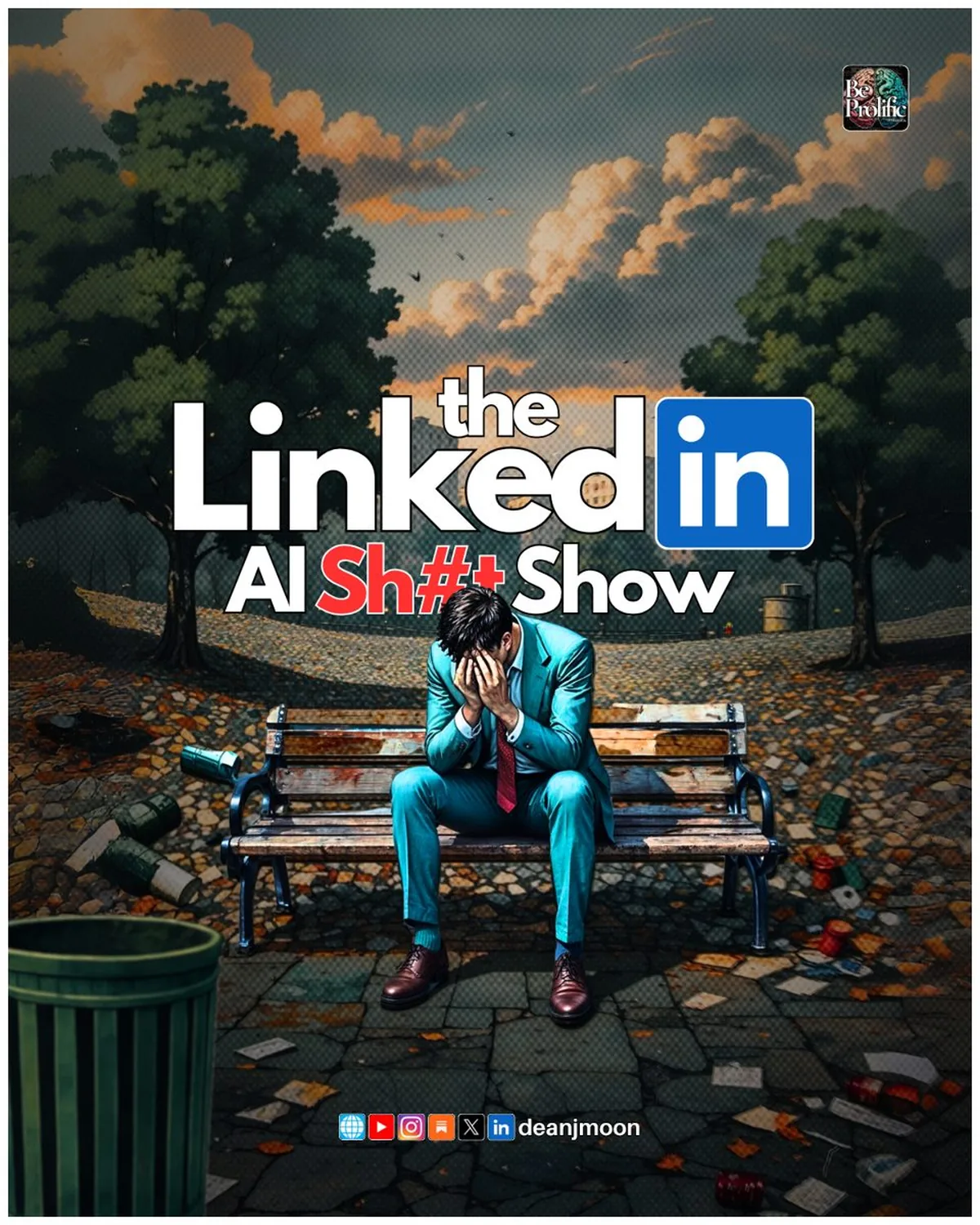
Summary
Dean challenges the label "AI slop". His argument is that slop is the lazy output of lazy people, and that people were filling social feeds with throwaway content long before generative AI arrived. He cites an Originality.AI finding that 81.2% of long-form LinkedIn posts were classified "Likely AI" in July 2026, raises model training, watermarking and an unanswered IP infringement question he put to an Australian Computer Society event in 2024, then turns the critique on the reader: audit your own creative, positioning and messaging before you hit the AI slop button on somebody else's work.
Who wrote it
- 95%Dean's words
- 0%Assisted
- 5%Originated by Claude, cleared by Dean
Share of the 2,515 published characters. Everything Claude did not originate is Dean's, dictated or typed.
The post as published
Since November 2022, the proliferation of generative AI has had significant effects on the modern workforce.
81.2% of long-form LinkedIn posts were classified "Likely AI" in July 2026, up from roughly half in late 2024 (Originality.AI)
One of the consequences, however, is this concept of AI slop.
But I want to challenge this narrative.
I want to challenge why we label it as AI slop, when it is just the lazy output of lazy people.
If you were to go into the workplace and you produced rubbish output for your work, you would literally get fired.
And once that took place, that would be the end of it.
You wouldn't hear any more.
But it seems that people like to make a lot of noise saying, "this is AI slop, and this is that, and this is this".
More content is being produced and disseminated than ever before.
The problem with this is that models need to be trained on updated data inputs.
And as we compound that same problem, new things have had to evolve, like watermarking and making sure that there's a level of authenticity.
At an event back at the Australian Computer Society in 2024, I raised the question about IP infringement.
There wasn't an answer to that.
In fact, people hadn't thought about it.
But I want to go back to a step before that.
Who creates the slop?
And the slop is, unfortunately, people.
We've seen this through the proliferation of social media.
Cat videos on YouTube. Dancing memes on TikTok. Food and holiday snaps on Instagram.
Do we care?
Yet people seem to want to have such an opinion on social, whereas in reality, one would just ignore it and turn the other cheek.
And now we have to have buttons and comments and opinions about somebody else's work.
I'd like to offer an alternative.
Rather than critiquing somebody else's content, how about you critique your own?
How effective is your creative? How effective is your positioning? How effective is your messaging? How effective is the entire package?
Because whilst it's easy to point the finger the other way, there's usually four fingers coming straight back.
Whilst we live in this world where content will proliferate, and content compounds over content on top, we unfortunately don't have a short-term solution to improve quality.
Yet quality is a subjective concept.
One person's trash is another's treasure.
The next time you hit that AI slop button, wonder who's done that to you.
And would you get offended?
What digital trash did you litter in your wake?
How it was made
v1 Dictation
Dean · Voice dictation into Claude · 2026-10-07 · 2,521 characters
Raw thoughts, one pass. Source of truth for the copy.
Read this version
I'm just going to give you a series of thoughts and then we're going to work on the copy and so since November 2022 the proliferation of generative AI has had significant effects the modern workforce. One of the consequences, however, is this idea or this concept of AI slop. But I want to challenge this narrative. I want to challenge why we label it as AI slop when really it is just the lazy output of lazy people. If you were to go into the workplace and you produced rubbish output for your work, you would literally get fired. And once that took place, that would be the end of it. You wouldn't hear any more. But it seems to be that people like to make a lot of noise saying, this is AI slop and this is that and this is this. And the reality is more content is being produced and disseminated than ever before. The problem with this is that data, that models need to be trained on updated data inputs. And as we compound that same problem, new things have had to evolve like watermarking and making sure that there's a level of authenticity. But that said, an event back at the Australian Computer Society in 2024, I raised the question about IP infringement. There really wasn't an answer to that. In fact, people hadn't really thought about it. But I want to go back to a step before that. Who creates the slop? And the slop is unfortunately people. We've seen this through the proliferation of social media, cat videos on YouTube, dancing memes on TikTok, and food and holiday snaps on Instagram. Do we really care? Yet people seem to want to have such an opinion on social, whereas in reality, one would just ignore it and turn the other cheek. And so now we have to actually have buttons and comments and opinions about somebody else's work. I'd like to offer a con- an alternative. Rather than critiquing somebody else's content, how about you cont- how about you critique your own? How effective is your messaging? How effective is your creative? How effective is the entire package? How effective is your positioning? Because whilst it's easy to go point the finger the other way, there's usually four fingers coming straight back. And whilst we live in this world where content will proliferate and we will compound content on top of content, we unfortunately don't have a short-term solution to improve quality. But yet quality is a subjective concept. One person's trash is another's treasure. So when the next time you hit that AI slop button, wonder who's done that to you and would you get offended?
SHA-256 ad615cf892621e689435b7fdfb3b01d592a462dc78475cbf2698d51c0e013c5b · exact text
v2 Clean pass
Claude · Claude (claude-opus-5-5) · 2026-10-07 · 2,342 characters
Transcription cleaned, banned phrases removed, four section breaks. Nothing added or cut. One open marker: four fingers.
Read this version
Since November 2022, the proliferation of generative AI has had significant effects on the modern workforce.
One of the consequences, however, is this concept of AI slop.
But I want to challenge this narrative.
I want to challenge why we label it as AI slop, when it is just the lazy output of lazy people.
If you were to go into the workplace and you produced rubbish output for your work, you would literally get fired.
And once that took place, that would be the end of it.
You wouldn't hear any more.
But it seems that people like to make a lot of noise saying, "this is AI slop, and this is that, and this is this".
More content is being produced and disseminated than ever before.
The problem with this is that models need to be trained on updated data inputs.
And as we compound that same problem, new things have had to evolve, like watermarking and making sure that there's a level of authenticity.
At an event back at the Australian Computer Society in 2024, I raised the question about IP infringement.
There wasn't an answer to that.
In fact, people hadn't thought about it.
But I want to go back to a step before that.
Who creates the slop?
And the slop is, unfortunately, people.
We've seen this through the proliferation of social media.
Cat videos on YouTube. Dancing memes on TikTok. Food and holiday snaps on Instagram.
Do we care?
Yet people seem to want to have such an opinion on social, whereas in reality, one would just ignore it and turn the other cheek.
And now we have to have buttons and comments and opinions about somebody else's work.
I'd like to offer an alternative.
Rather than critiquing somebody else's content, how about you critique your own?
How effective is your messaging? How effective is your creative? How effective is the entire package? How effective is your positioning?
Because whilst it's easy to point the finger the other way, there's usually [? four ] fingers coming straight back.
Whilst we live in this world where content will proliferate, and we will compound content on top of content, we unfortunately don't have a short-term solution to improve quality.
Yet quality is a subjective concept.
One person's trash is another's treasure.
The next time you hit that AI slop button, wonder who's done that to you.
And would you get offended?
SHA-256 8aa9b3aaec117ad303a38856bc4a46c7efb6ac74671b0837702e9b7ae536ff6f · exact text
v3 Dean edit
Dean · AuthoredUp · 2026-10-07 · 2,498 characters
Added the 81.2% stat, reordered the four questions, reworded the compound line, added the litter line.
Read this version
Since November 2022, the proliferation of generative AI has had significant effects on the modern workforce.
81.2% of long-form LinkedIn posts were classified "Likely AI" in July 2026, up from roughly half in late 2024
One of the consequences, however, is this concept of AI slop.
But I want to challenge this narrative.
I want to challenge why we label it as AI slop, when it is just the lazy output of lazy people.
If you were to go into the workplace and you produced rubbish output for your work, you would literally get fired.
And once that took place, that would be the end of it.
You wouldn't hear any more.
But it seems that people like to make a lot of noise saying, "this is AI slop, and this is that, and this is this".
More content is being produced and disseminated than ever before.
The problem with this is that models need to be trained on updated data inputs.
And as we compound that same problem, new things have had to evolve, like watermarking and making sure that there's a level of authenticity.
At an event back at the Australian Computer Society in 2024, I raised the question about IP infringement.
There wasn't an answer to that.
In fact, people hadn't thought about it.
But I want to go back to a step before that.
Who creates the slop?
And the slop is, unfortunately, people.
We've seen this through the proliferation of social media.
Cat videos on YouTube. Dancing memes on TikTok. Food and holiday snaps on Instagram.
Do we care?
Yet people seem to want to have such an opinion on social, whereas in reality, one would just ignore it and turn the other cheek.
And now we have to have buttons and comments and opinions about somebody else's work.
I'd like to offer an alternative.
Rather than critiquing somebody else's content, how about you critique your own?
How effective is your creative? How effective is your positioning? How effective is your messaging? How effective is the entire package?
Because whilst it's easy to point the finger the other way, there's usually four fingers coming straight back.
Whilst we live in this world where content will proliferate, and content compounds over content on top, we unfortunately don't have a short-term solution to improve quality.
Yet quality is a subjective concept.
One person's trash is another's treasure.
The next time you hit that AI slop button, wonder who's done that to you.
What digital trash did you litter in your wake?
And would you get offended?
SHA-256 6f3bf499fbe2b854c25ea67cba71f4682d19acea600b84e705f34d697b8c470a · exact text
v4 Draft fixes
Claude · Claude via AuthoredUp API · 2026-10-07 · 2,502 characters
On Dean's instruction: compound line restored, close reordered. Did not carry to the scheduled post.
Read this version
Since November 2022, the proliferation of generative AI has had significant effects on the modern workforce.
81.2% of long-form LinkedIn posts were classified "Likely AI" in July 2026, up from roughly half in late 2024
One of the consequences, however, is this concept of AI slop.
But I want to challenge this narrative.
I want to challenge why we label it as AI slop, when it is just the lazy output of lazy people.
If you were to go into the workplace and you produced rubbish output for your work, you would literally get fired.
And once that took place, that would be the end of it.
You wouldn't hear any more.
But it seems that people like to make a lot of noise saying, "this is AI slop, and this is that, and this is this".
More content is being produced and disseminated than ever before.
The problem with this is that models need to be trained on updated data inputs.
And as we compound that same problem, new things have had to evolve, like watermarking and making sure that there's a level of authenticity.
At an event back at the Australian Computer Society in 2024, I raised the question about IP infringement.
There wasn't an answer to that.
In fact, people hadn't thought about it.
But I want to go back to a step before that.
Who creates the slop?
And the slop is, unfortunately, people.
We've seen this through the proliferation of social media.
Cat videos on YouTube. Dancing memes on TikTok. Food and holiday snaps on Instagram.
Do we care?
Yet people seem to want to have such an opinion on social, whereas in reality, one would just ignore it and turn the other cheek.
And now we have to have buttons and comments and opinions about somebody else's work.
I'd like to offer an alternative.
Rather than critiquing somebody else's content, how about you critique your own?
How effective is your creative? How effective is your positioning? How effective is your messaging? How effective is the entire package?
Because whilst it's easy to point the finger the other way, there's usually four fingers coming straight back.
Whilst we live in this world where content will proliferate, and we will compound content on top of content, we unfortunately don't have a short-term solution to improve quality.
Yet quality is a subjective concept.
One person's trash is another's treasure.
The next time you hit that AI slop button, wonder who's done that to you.
And would you get offended?
What digital trash did you litter in your wake?
SHA-256 2df26a5e22279158eb719c8813cad27f1919b539086180d66f8a4454a42e2128 · exact text
v5 Published
Dean · AuthoredUp, scheduled post · 2026-10-07 · 2,515 characters
Source added to the stat line, close reordered. Compound line kept as Dean's v3 wording.
Read this version
Since November 2022, the proliferation of generative AI has had significant effects on the modern workforce.
81.2% of long-form LinkedIn posts were classified "Likely AI" in July 2026, up from roughly half in late 2024 (Originality.AI)
One of the consequences, however, is this concept of AI slop.
But I want to challenge this narrative.
I want to challenge why we label it as AI slop, when it is just the lazy output of lazy people.
If you were to go into the workplace and you produced rubbish output for your work, you would literally get fired.
And once that took place, that would be the end of it.
You wouldn't hear any more.
But it seems that people like to make a lot of noise saying, "this is AI slop, and this is that, and this is this".
More content is being produced and disseminated than ever before.
The problem with this is that models need to be trained on updated data inputs.
And as we compound that same problem, new things have had to evolve, like watermarking and making sure that there's a level of authenticity.
At an event back at the Australian Computer Society in 2024, I raised the question about IP infringement.
There wasn't an answer to that.
In fact, people hadn't thought about it.
But I want to go back to a step before that.
Who creates the slop?
And the slop is, unfortunately, people.
We've seen this through the proliferation of social media.
Cat videos on YouTube. Dancing memes on TikTok. Food and holiday snaps on Instagram.
Do we care?
Yet people seem to want to have such an opinion on social, whereas in reality, one would just ignore it and turn the other cheek.
And now we have to have buttons and comments and opinions about somebody else's work.
I'd like to offer an alternative.
Rather than critiquing somebody else's content, how about you critique your own?
How effective is your creative? How effective is your positioning? How effective is your messaging? How effective is the entire package?
Because whilst it's easy to point the finger the other way, there's usually four fingers coming straight back.
Whilst we live in this world where content will proliferate, and content compounds over content on top, we unfortunately don't have a short-term solution to improve quality.
Yet quality is a subjective concept.
One person's trash is another's treasure.
The next time you hit that AI slop button, wonder who's done that to you.
And would you get offended?
What digital trash did you litter in your wake?
SHA-256 182535ae5e1e96712cb1500b8f8825ce1f5734a501694f8b5f07fe45107cffa0 · exact text
What changed between draft and published
Added
- 81.2% of long-form LinkedIn posts were classified "Likely AI" in July 2026, up from roughly half in late 2024 (Originality.AI)
- What digital trash did you litter in your wake?
Reworded
- Whilst we live in this world where content will proliferate, and we will compound content on top of content, we unfortunately don't have a short-term solution to improve quality.
Whilst we live in this world where content will proliferate, and content compounds over content on top, we unfortunately don't have a short-term solution to improve quality.
Lines were also reordered.
Dean edits by addition, not by cutting: he puts a hard number second from the top, orders a list so the widest item comes last, and closes on a new question that points back at the tile image.
AI involvement
Lines Claude originated that Dean reviewed and kept:
- 81.2% of long-form LinkedIn posts were classified "Likely AI" in July 2026, up from roughly half in late 2024 (Originality.AI)
Claude (claude-opus-5-5): Alt text, clean pass, research, post-publish workflow, record.
Sources
Check it yourself
Each version above carries a SHA-256 fingerprint of its exact text. Download the published text, hash it, and it matches this one:
182535ae5e1e96712cb1500b8f8825ce1f5734a501694f8b5f07fe45107cffa0
Machine-readable record: this page carries schema.org data listing every version, who wrote it and when.