Prolific Provenance
The Golden Ratio
The post as published
What is the correct ratio?
the correct ratio of business vs personal content? the correct number of follow-up phone calls? the correct amount of direct outreach? the correct number of cold emails?
The answer is?
It depends.
In a changing, dynamic market, there is no simple answer.
The only thing you can control is the level of output that you have.
The Golden Ratio
The golden ratio, also known as the golden number, golden proportion or the divine proportion.
It’s a ratio between two numbers that equals approximately 1.618.
It's understood that the ancient Greeks used the golden ratio in the architecture of their buildings.
More importantly, they worked with systems, symmetry and formulas.
My Golden Ratio
My simple rule of thumb is roughly a 70-30 split.
70% business versus 30% personal.
Sunday, I usually post about my faith.
During the week, I might post about a friend or a catch-up that I've had.
The other days, I'll talk about social go-to-market, content positioning and how to create content with AI.
That ratio is important because without that, you can burn out quickly.
Understand what's right for you!
내일 봐요 ✌️
Dean Moon (Moonie)
Executive Insight is YOUR defensible moat.
BeProlific
Inspiration and process
Dean, dictated after posting. Tidied by Claude at Dean's request: filler cut, his words kept, facts corrected.
Whilst I started doing this 30 for 30, I realised that it was relatively loose with what I was writing and what I was producing and putting out.
I realised that I'd moved away from having two content or expertise pillars that I wanted to write about, and then having my personal pillar.
But I wanted to add a slightly different dimension to this, and so that's why the image is a little bit more 3D, and you can see the guy from the front, from an angle, whereas the other two images that I'd done were all in 2D.
I think the golden ratio was also relevant because of the way that I put the images together. But I had content pillars or expertise pillars as the previous hero copy on the images, and this time I wanted to talk about ratios.
I felt as though a lot's changed with all the algorithmic updates on LinkedIn and how AI has affected reach, and I had to anchor back down to what it is that you do, core or fundamentally, away from what's actually changing.
And that is, a big chunk of my content is focused on ICP, and then a third or a certain percentage is personal. The personal stuff is usually my faith and the odd one about my family.
The ICP, or the big chunk, in this post I said 70%, is probably around AI and content. It's around messaging and positioning, which I haven't written a lot about in this sprint, and I need to start writing about sales and go-to-market.
So it was more a creative exercise in just getting that image slightly tweaked, and then talking about ratios.
The next thing is just to sit down and write about those core ideas or those expertise pillars, and then focus on how they align and come closer, because the algorithms are getting so specific that you need to be really, really specific.
But the personal content is the one that actually helps proliferate your brand across a number of different people and genres. So that's why that's important, whilst it's not going to help with the positioning and the messaging of what you actually do.
As far as the copy and how it came out, I wrote it a while ago. I think it was the 4th of November, and then I sat on it. Then I couldn't find the thread in my code session, so I asked for it to do a search, and it just created a new one, which was quite frustrating. So I'm working in that thread right now.
But I guess ultimately it just comes down to execution, because you've got to get the numbers out. So that's what this is about.
The dictation, verbatim
Whilst I started doing this 30 for 30, I realized that it was relatively loose with what I was writing and what I was producing and putting out.
And I realized that I sort of moved away from, you know, having two focuses and then two content or expertise pillars that I wanted to write about, and then having my personal my pillar.
But I wanted to add a slightly different dimension to this, and so that's why the image is a little bit more 3D, and you can kind of see the guy from the front from an angle, whereas the other two images that I'd done were all in 2D.
But I think also the golden ratio was relevant because of like the way that I put the images together, but then I had content pillars or expertise pillars as the previous hero copy on the images, and this time I want to talk about ratios because I felt as though that a lot's changed with all the algorithmic updates on LinkedIn, how AI has affected reach, and I had to anchor back down to, like, you know, what is it that you do core or fundamentally away from what's actually changing, and that is, you know, a big chunk of my content is focused on ICP, and then you know a third or a certain percentage is personal, and the personal stuff is usually my faith and the odd one about my family, and the ICP or the big chunk, or in this case in this post I said 70%, it's probably around about AI and content.
It's around about messaging and positioning, which I haven't written a lot about in this particular in this sprint, and I need to start writing about sales and go to market.
And so I think, you know, it was more a creative exercise in just getting that image slightly tweaked, and then talking about ratios.
And I think next thing is just to sit down and write about those core ideas or those expertise pillars, and then focus on how do they kind of align and come closer, because the algorithms are getting so specific that you need to be really, really specific.
But the personal content is the one that actually helps proliferate your brand across, you know, a number of different people and genres and things like that. So that's why that's important.
Whilst it's not going to help with the positioning and the positioning and the messaging of what you actually do. So that's what this was about. And as far as the copy and how it came out, I wrote it a while ago.
I think it was like the 4th of November, and then I sat on it, and then I couldn't find the thread in my code session, so I asked for it to actually do a search, and it just created a new one, which was quite frustrating.
So I'm actually working in that particular thread right now, but I guess ultimately it just comes down to just execution, because, you know, you've got to get the numbers out. So that's what this is about.
How the image was made
Dean wanted a different dimension from the two earlier tiles, which were flat and side-on. This one is drawn in 3D, with the stonemason seen from the front at an angle.
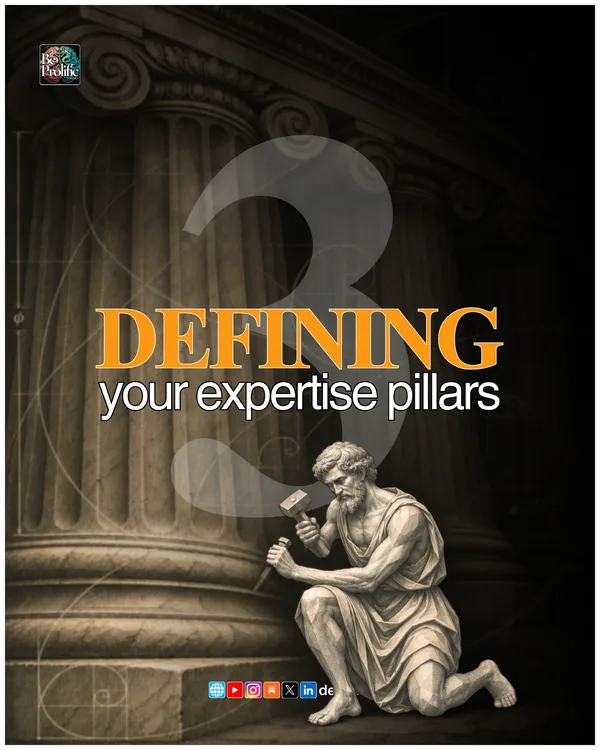
Dean, in CanvaFirst versionAs Dean sent it on 4 November: DEFINING your expertise pillars over a large 3. After dictating, he noticed the copy was about ratios and output, so the headline no longer matched. 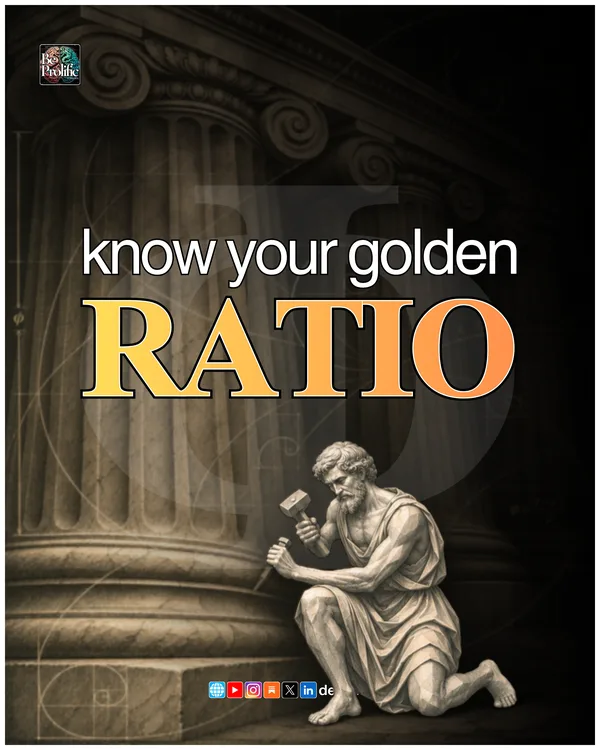
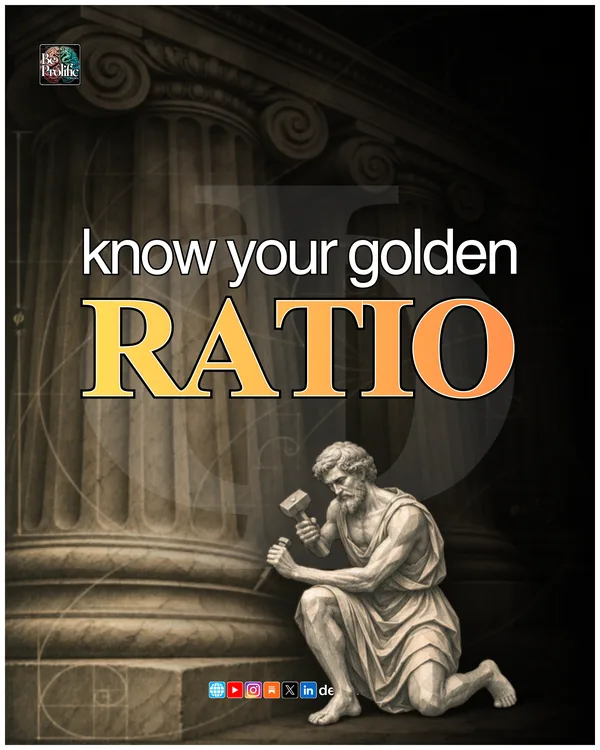
Dean, in CanvaFinal tileDean changed the headline to know your golden RATIO the same day. Posted 15 November.


Lineage
The two earlier posts built on the same image: a Greek stonemason carving a pillar, with golden ratio spirals drawn over the stone. Both were about content pillars. Oldest first.
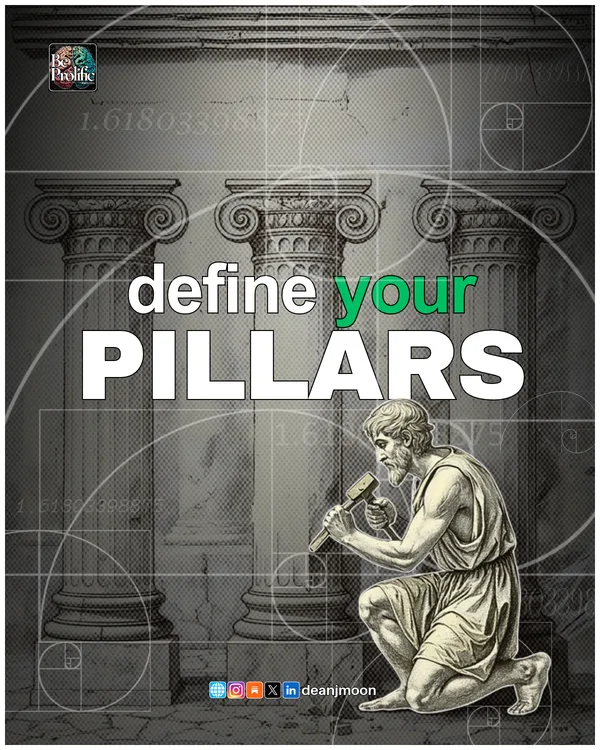
23 August 2025Know Your PillarsHeadline: define your PILLARS. A flat, side-on drawing of three Ionic columns with 1.618 written across the stone. The copy explained the golden ratio and the Greeks, the section this post reuses.On LinkedIn 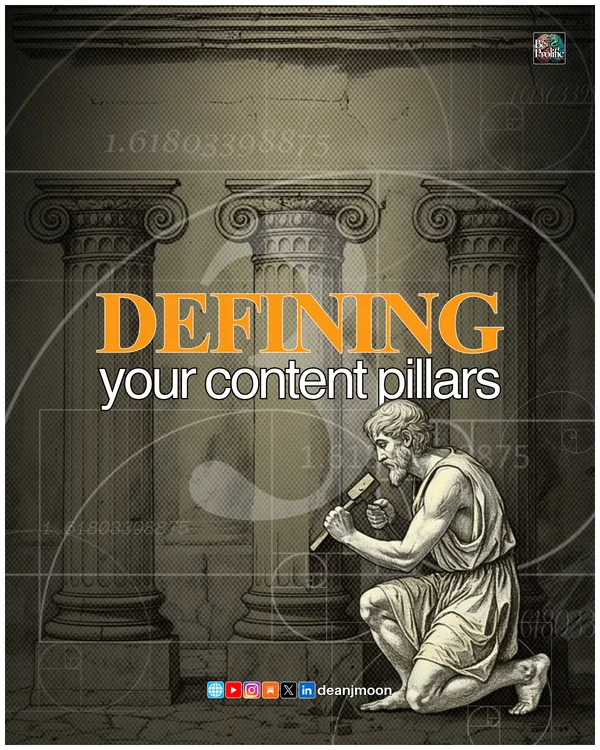
7 October 2025Defining Your Content PillarsHeadline: DEFINING your content pillars, over a large 3. The same flat drawing in a warmer tone.On LinkedIn


How the words were made
- Dean
- Claude
v1Raw dictation
8,393 characters · Voice dictation into Claude
Dean's dictation, 2026.11.04, speech-to-text, unedited.
Read this version
So I'm going to open with a question. What is the correct ratio of posts, of ideas, of messages that you need to send? What is the correct ratio of business ICP focused content versus personal content? What is the correct amount of direct outreach?
What is the correct amount of marketing events? What is the correct amount of content marketing, content pieces? What is the correct number of follow-up phone calls? What is the correct number of cold emails that we need to send out?
What is the correct ratio of all of these activities that we need to do to find the optimal result that we're looking for? The answer is it depends. And in a changing dynamic market, there is no simple answer. The only thing you can do is you can control the level of output that you have.
Now, interestingly, when I look at the creator gurus, they talk about things like, you've got to send this many messages, you've got to send this many DMs, you've got to get this much engagement going on, you've got to get this many impressions out, you've got to get this, you've got to get that, you've got to do so many things.
But at the heart of it, for all of those professionals, executives and hyperscalers, founders that lead their sales and growth operations, this is a challenge because you are running a business and your role is not to be a content creator. Content is just a piece of the marketing.
It is one of the many different disciplines in your business that you need to be overseeing.
And again, you would have a certain ratio of time that you would put towards your marketing versus your financing, financing versus your production, your engineering, your sales, your go to market, all of that sort of stuff. So what is the perfect ratio? And again, it depends.
What I want to talk about in this particular post is understanding and defining your expertise pillars. And the concept there is getting the right ratio of expertise versus personal posts. And I'll say this to make it very, very clear.
In a dynamic changing market, especially on social, where the algorithms are constantly changing, the one thing that you need to do is be consistent. Because your content needs to be consistently going out.
Posting once every 6 months and getting virality because you've just been laid off or you've just changed jobs is not going to drive net new business. What you're going to get is you're going to get a whole bunch of barnacles reaching out and saying, yay, that's fantastic.
And then it'll die down and you'll get your little dopamine hit and you'll feel really, really nice for that post, but it does absolutely nothing for the long term. My simple rule of thumb is have roughly a 70-30% split on what that looks like for your content.
And that basically means 2 to 3 pieces of business content per week, 1 personal. Now, that's what I do. And the way that I break it up is I normally have 1 or 2 normal, 1 or 2 personal pieces of content, and I break it down into simple math. Sunday, I usually post about my faith.
It's a personal post. I remove all my branding, and all I do is either link it to the sermon series at my church or something that I'm reading. I look for an image, and I share a personal reflection with a piece of scripture, and I link it back to the church's YouTube live stream channel.
Why? Because faith is important, and as you can see on my profile, it's Christian, husband, father. So that's 1. Then during the week, I might post about a friend or a catch-up that I've had.
And the way that I do it is I write about a story, and that story is how we met, the influences and the reflections that I have about them, and why the relationship is valuable to me. And I talk about them, not so much about me. I focus on who they are and what they did.
And why do I do that? Because I'm leveraging their network. And what will happen is you'll end up getting a far greater outreach of your content. You'll get a greater number of impressions because you're leveraging their network.
And everybody that knows that person will start to engage in that content. You will see a farther out-of-network reach versus your in-network reach. That's just a given. The other days, I'll talk about social go-to-market.
I'll talk about content positioning and how to create content with AI. I might even talk a little bit about AI. What I need to do is I need to sit down and work out what are my expertise pillars.
And there's a number of things that I've been doing over the last several months, and there's been a number of different things that I've been doing over the last several years since I got out of corporate.
But having said that, the fundamental skills of what I've actually got are still seeping through everything that I do. So I know how to do outreach for cold market. I know how to develop a partner program. I know how to get referrals. I know how to sell. I know how to do a presentation.
I know how to use AI. I know how to create content. I know how to create applications through vibe coding now. There's a number of things that I can do.
But as far as what my audience needs to see or my target audience needs to see, they need to see consistency in the output of the messaging of my content. And without that, there is no lock-in to what I actually do. They cannot see what I do.
Most recently, I updated my website and I started to use all of my content as collateral for the website. Unlike typical websites, when you mouse over my on the main page, you'll see that the tiles will start to come up. Why?
Because I'm showcasing the level of output that I've actually had. But that's over the last number of years. So I've got over 700 odd content collateral with copy, ideas, thoughts, and images in there.
So when I talk about something, I talk about it from a place of understanding because I've done the research and I've done the work. But when it comes to getting this message out, what is the optimal amount of pieces of content that need to go out on my LinkedIn profile?
And that's really up to me. So I try and post every day. The idea is to get roughly a ratio of 70-30%, or let's say 70-30% business versus 30% personal. And there's more about why I do the 30% personal now and the look at me content.
That ratio is really, really important because without that, you can burn out very, very quickly. When you look at the current content gurus, there's been a vast shift in what they've been talking about in the last number of years.
They'll talk about you need to write particular content about what your offer is. You need to focus on who that is. Then it went to you need to have more engagement and reach, and this is what you need to do. Comment on all of these people.
Then they said now it's gone to now you need to write more personal content because of 360 Brew. Now it's shifted to now you've got to send a whole bunch of DMs to try and get leads.
The reality is when you start to chase all these fads all the time, you don't actually get any consistency in what you're trying to do.
Content at the highest level or social thought leadership is basically anchoring back into your core fundamentals of who and what you are and what your expertise is. Based on that, you can then produce content to help support your outreach, which I call social go-to-market.
Content and social selling or social outreach is emotion. And again, what is the ratio versus phone calls, emails, events, content marketing, downloadables, everything else? And you don't know what that is unless you get established a baseline.
So understand and define what your expertise pillars are, and then understand what's right for you. But without a level of consistency, you can't define what success is going to look like.
I've noticed that I've said in the image, the image is a define your expertise pillars, but what I've really talked about is like the number of outputs that you actually need to create.
I'm wondering, can you edit the copy to make it align with the expertise pillars, or should I just update the image so that it is understanding your know your golden ratio?
And then I think we need to put in a little section about the golden ratio with the Greeks with their architecture and their art and all that sort of stuff. So you can draw upon that from the other posts, but let's just look at that first part of the initial messaging of what the content
SHA-256 9f320f6385727b317715c5b870df393c8f1526b0ca009d6d6473258d77758042 · exact text
v2Tidied by AI
8,316 characters · Claude (claude-fable-5-2)
Claude: paragraph breaks added; "emotion" fixed to "a motion", the doubled 70-30% untangled, three slips removed. Hand-marked.
Read this version
What is the correct ratio of posts, of ideas, of messages that you need to send? What is the correct ratio of business ICP focused content versus personal content? What is the correct amount of direct outreach? What is the correct amount of marketing events?
What is the correct amount of content marketing, content pieces? What is the correct number of follow-up phone calls? What is the correct number of cold emails that we need to send out?
What is the correct ratio of all of these activities that we need to do to find the optimal result that we're looking for? The answer is it depends. And in a changing dynamic market, there is no simple answer. The only thing you can do is you can control the level of output that you have.
Now, interestingly, when I look at the creator gurus, they talk about things like, you've got to send this many messages, you've got to send this many DMs, you've got to get this much engagement going on, you've got to get this many impressions out, you've got to get this, you've got to get that, you've got to do so many things.
But at the heart of it, for all of those professionals, executives and hyperscalers, founders that lead their sales and growth operations, this is a challenge because you are running a business and your role is not to be a content creator. Content is just a piece of the marketing.
It is one of the many different disciplines in your business that you need to be overseeing.
And again, you would have a certain ratio of time that you would put towards your marketing versus your financing, financing versus your production, your engineering, your sales, your go to market, all of that sort of stuff.
So what is the perfect ratio? And again, it depends. What I want to talk about in this particular post is understanding and defining your expertise pillars. And the concept there is getting the right ratio of expertise versus personal posts. And I'll say this to make it very, very clear.
In a dynamic changing market, especially on social, where the algorithms are constantly changing, the one thing that you need to do is be consistent. Because your content needs to be consistently going out.
Posting once every 6 months and getting virality because you've just been laid off or you've just changed jobs is not going to drive net new business. What you're going to get is you're going to get a whole bunch of barnacles reaching out and saying, yay, that's fantastic.
And then it'll die down and you'll get your little dopamine hit and you'll feel really, really nice for that post, but it does absolutely nothing for the long term.
My simple rule of thumb is have roughly a 70-30 split on what that looks like for your content. And that basically means 2 to 3 pieces of business content per week, 1 personal. Now, that's what I do. And the way that I break it up is I normally have 1 or 2 normal, 1 or 2 personal pieces of content, and I break it down into simple math.
Sunday, I usually post about my faith. It's a personal post. I remove all my branding, and all I do is either link it to the sermon series at my church or something that I'm reading.
I look for an image, and I share a personal reflection with a piece of scripture, and I link it back to the church's YouTube live stream channel. Why? Because faith is important, and as you can see on my profile, it's Christian, husband, father. So that's 1.
Then during the week, I might post about a friend or a catch-up that I've had. And the way that I do it is I write about a story, and that story is how we met, the influences and the reflections that I have about them, and why the relationship is valuable to me.
And I talk about them, not so much about me. I focus on who they are and what they did. And why do I do that? Because I'm leveraging their network. And what will happen is you'll end up getting a far greater outreach of your content.
You'll get a greater number of impressions because you're leveraging their network. And everybody that knows that person will start to engage in that content. You will see a farther out-of-network reach versus your in-network reach. That's just a given.
The other days, I'll talk about social go-to-market. I'll talk about content positioning and how to create content with AI. I might even talk a little bit about AI.
What I need to do is I need to sit down and work out what are my expertise pillars.
And there's a number of things that I've been doing over the last several months, and there's been a number of different things that I've been doing over the last several years since I got out of corporate.
But having said that, the fundamental skills of what I've actually got are still seeping through everything that I do. So I know how to do outreach for cold market. I know how to develop a partner program. I know how to get referrals. I know how to sell. I know how to do a presentation.
I know how to use AI. I know how to create content. I know how to create applications through vibe coding now. There's a number of things that I can do.
But as far as what my audience needs to see or my target audience needs to see, they need to see consistency in the output of the messaging of my content. And without that, there is no lock-in to what I actually do. They cannot see what I do.
Most recently, I updated my website and I started to use all of my content as collateral for the website. Unlike typical websites, when you mouse over the main page, you'll see that the tiles will start to come up. Why? Because I'm showcasing the level of output that I've actually had.
But that's over the last number of years. So I've got over 700 odd content collateral with copy, ideas, thoughts, and images in there. So when I talk about something, I talk about it from a place of understanding because I've done the research and I've done the work.
But when it comes to getting this message out, what is the optimal amount of pieces of content that need to go out on my LinkedIn profile? And that's really up to me. So I try and post every day. The idea is to get roughly a ratio of 70% business versus 30% personal.
And there's more about why I do the 30% personal now and the look at me content. That ratio is really, really important because without that, you can burn out very, very quickly.
When you look at the current content gurus, there's been a vast shift in what they've been talking about in the last number of years. They'll talk about you need to write particular content about what your offer is. You need to focus on who that is.
Then it went to you need to have more engagement and reach, and this is what you need to do. Comment on all of these people. Then they said now it's gone to now you need to write more personal content because of 360 Brew.
Now it's shifted to now you've got to send a whole bunch of DMs to try and get leads. The reality is when you start to chase all these fads all the time, you don't actually get any consistency in what you're trying to do.
Content at the highest level or social thought leadership is basically anchoring back into your core fundamentals of who and what you are and what your expertise is. Based on that, you can then produce content to help support your outreach, which I call social go-to-market.
Content and social selling or social outreach is a motion. And again, what is the ratio versus phone calls, emails, events, content marketing, downloadables, everything else? And you don't know what that is unless you get established a baseline.
So understand and define what your expertise pillars are, and then understand what's right for you. But without a level of consistency, you can't define what success is going to look like.
I've noticed that I've said in the image, the image is define your expertise pillars, but what I've really talked about is like the number of outputs that you actually need to create.
I'm wondering, can you edit the copy to make it align with the expertise pillars, or should I just update the image so that it is know your golden ratio?
And then I think we need to put in a little section about the golden ratio with the Greeks with their architecture and their art and all that sort of stuff. So you can draw upon that from the other posts, but let's just look at that first part of the initial messaging of what the content
SHA-256 5e3d9f6852d8c519439d4a1feb781ac4fa32c686505344015c5a9b21214f3889 · exact text
What changed from the version before
Added by Claude
RemovedSo I'm going to open with a question.What is the correct ratio of posts, of ideas, of messages that you need to send? What is the correct ratio of business ICP focused content versus personal content? What is the correct amount of direct outreach?What is the correct amount of marketing events? What is the correct amount of content marketing, content pieces? What is the correct number of follow-up phone calls? What is the correct number of cold emails that we need to send out?
What is the correct ratio of all of these activities that we need to do to find the optimal result that we're looking for? The answer is it depends. And in a changing dynamic market, there is no simple answer. The only thing you can do is you can control the level of output that you have.
Now, interestingly, when I look at the creator gurus, they talk about things like, you've got to send this many messages, you've got to send this many DMs, you've got to get this much engagement going on, you've got to get this many impressions out, you've got to get this, you've got to get that, you've got to do so many things.
But at the heart of it, for all of those professionals, executives and hyperscalers, founders that lead their sales and growth operations, this is a challenge because you are running a business and your role is not to be a content creator. Content is just a piece of the marketing.
It is one of the many different disciplines in your business that you need to be overseeing.
And again, you would have a certain ratio of time that you would put towards your marketing versus your financing, financing versus your production, your engineering, your sales, your go to market, all of that sort of stuff.
So what is the perfect ratio? And again, it depends. What I want to talk about in this particular post is understanding and defining your expertise pillars. And the concept there is getting the right ratio of expertise versus personal posts. And I'll say this to make it very, very clear.
In a dynamic changing market, especially on social, where the algorithms are constantly changing, the one thing that you need to do is be consistent. Because your content needs to be consistently going out.
Posting once every 6 months and getting virality because you've just been laid off or you've just changed jobs is not going to drive net new business. What you're going to get is you're going to get a whole bunch of barnacles reaching out and saying, yay, that's fantastic.
And then it'll die down and you'll get your little dopamine hit and you'll feel really, really nice for that post, but it does absolutely nothing for the long term.
My simple rule of thumb is have roughly a 70-30
%split on what that looks like for your content. And that basically means 2 to 3 pieces of business content per week, 1 personal. Now, that's what I do. And the way that I break it up is I normally have 1 or 2 normal, 1 or 2 personal pieces of content, and I break it down into simple math.Sunday, I usually post about my faith. It's a personal post. I remove all my branding, and all I do is either link it to the sermon series at my church or something that I'm reading.
I look for an image, and I share a personal reflection with a piece of scripture, and I link it back to the church's YouTube live stream channel. Why? Because faith is important, and as you can see on my profile, it's Christian, husband, father. So that's 1.
Then during the week, I might post about a friend or a catch-up that I've had. And the way that I do it is I write about a story, and that story is how we met, the influences and the reflections that I have about them, and why the relationship is valuable to me.
And I talk about them, not so much about me. I focus on who they are and what they did. And why do I do that? Because I'm leveraging their network. And what will happen is you'll end up getting a far greater outreach of your content.
You'll get a greater number of impressions because you're leveraging their network. And everybody that knows that person will start to engage in that content. You will see a farther out-of-network reach versus your in-network reach. That's just a given.
The other days, I'll talk about social go-to-market. I'll talk about content positioning and how to create content with AI. I might even talk a little bit about AI.
What I need to do is I need to sit down and work out what are my expertise pillars.
And there's a number of things that I've been doing over the last several months, and there's been a number of different things that I've been doing over the last several years since I got out of corporate.
But having said that, the fundamental skills of what I've actually got are still seeping through everything that I do. So I know how to do outreach for cold market. I know how to develop a partner program. I know how to get referrals. I know how to sell. I know how to do a presentation.
I know how to use AI. I know how to create content. I know how to create applications through vibe coding now. There's a number of things that I can do.
But as far as what my audience needs to see or my target audience needs to see, they need to see consistency in the output of the messaging of my content. And without that, there is no lock-in to what I actually do. They cannot see what I do.
Most recently, I updated my website and I started to use all of my content as collateral for the website. Unlike typical websites, when you mouse over
my onthe main page, you'll see that the tiles will start to come up. Why?Because I'm showcasing the level of output that I've actually had. But that's over the last number of years. So I've got over 700 odd content collateral with copy, ideas, thoughts, and images in there.
So when I talk about something, I talk about it from a place of understanding because I've done the research and I've done the work.
But when it comes to getting this message out, what is the optimal amount of pieces of content that need to go out on my LinkedIn profile? And that's really up to me. So I try and post every day.
The idea is to get roughly a ratio of
70-30%, or let's say 70-30%70% business versus 30% personal. And there's more about why I do the 30% personal now and the look at me content. That ratio is really, really important because without that, you can burn out very, very quickly.When you look at the current content gurus, there's been a vast shift in what they've been talking about in the last number of years. They'll talk about you need to write particular content about what your offer is. You need to focus on who that is.
Then it went to you need to have more engagement and reach, and this is what you need to do. Comment on all of these people. Then they said now it's gone to now you need to write more personal content because of 360 Brew.
Now it's shifted to now you've got to send a whole bunch of DMs to try and get leads. The reality is when you start to chase all these fads all the time, you don't actually get any consistency in what you're trying to do.
Content at the highest level or social thought leadership is basically anchoring back into your core fundamentals of who and what you are and what your expertise is. Based on that, you can then produce content to help support your outreach, which I call social go-to-market.
Content and social selling or social outreach is
emotiona motion. And again, what is the ratio versus phone calls, emails, events, content marketing, downloadables, everything else? And you don't know what that is unless you get established a baseline.So understand and define what your expertise pillars are, and then understand what's right for you. But without a level of consistency, you can't define what success is going to look like.
I've noticed that I've said in the image, the image is
adefine your expertise pillars, but what I've really talked about is like the number of outputs that you actually need to create.I'm wondering, can you edit the copy to make it align with the expertise pillars, or should I just update the image so that it is
understanding yourknow your golden ratio?And then I think we need to put in a little section about the golden ratio with the Greeks with their architecture and their art and all that sort of stuff. So you can draw upon that from the other posts, but let's just look at that first part of the initial messaging of what the content
v3Draft v1
974 characters · Claude (claude-opus-5-5)
Claude, 2026.11.04: opening section only, plus the Golden Ratio section reused from Dean's Know Your Pillars post (2025.08.23, layers/source-know-your-pillars.md). Sent to Dean in the first session. Marked against Tidied.
Read this version
What is the correct ratio?
What is the correct ratio of business, ICP-focused content versus personal content? What is the correct amount of direct outreach? Of marketing events? Of content pieces? Of follow-up phone calls? Of cold emails?
What is the correct ratio of all of these activities to find the result you're looking for?
The answer is, it depends.
In a changing, dynamic market, there is no simple answer.
The only thing you can control is the level of output that you have.
- - -
The Golden Ratio
The golden ratio, also known as the golden number, golden proportion or the divine proportion, is a ratio between two numbers that equals approximately 1.618.
It's understood that the ancient Greeks used the golden ratio in the architecture of their buildings.
These architectural masterpieces were built with precision.
More importantly, they worked with systems, symmetry and formulas.
My simple rule of thumb for content is roughly a 70-30 split.
SHA-256 6bac7a33c57143c157248f9bebbe80b17b01eb15275b5196b106319f0ca8ee53 · exact text
What changed from the version before
Added by Claude
RemovedWhat is the correct ratio?
of posts, of ideas, of messages that you need to send?What is the correct ratio of business,
ICP focusedICP-focused content versus personal content? What is the correct amount of direct outreach?What is the correct amountOf marketing events?What is the correct amountOf contentmarketing, contentpieces?What is the correct numberOf follow-up phone calls?What is the correct numberOf cold emails?that we need to send out?What is the correct ratio of all of these activities
that we need to doto find theoptimalresultthat we'reyou're looking for?The answer is, it depends.
AndIn a changing, dynamic market, there is no simple answer.The only thing you can
docontrol isyou can controlthe level of output that you have.Now, interestingly, when I look at the creator gurus, they talk about things like, you've got to send this many messages, you've got to send this many DMs, you've got to get this much engagement going on, you've got to get this many impressions out, you've got to get this, you've got to get that, you've got to do so many things.But at the heart of it, for all of those professionals, executives and hyperscalers, founders that lead their sales and growth operations, this is a challenge because you are running a business and your role is not to be a content creator.Content is just a piece of the marketing.It is one of the many different disciplines in your business that you need to be overseeing.And again, you would have a certain ratio of time that you would put towards your marketing versus your financing, financing versus your production, your engineering, your sales, your go to market, all of that sort of stuff.So what is the perfect ratio?And again, it depends.What I want to talk about in this particular post is understanding and defining your expertise pillars.And the concept there is getting the right ratio of expertise versus personal posts.And I'll say this to make it very, very clear.In a dynamic changing market, especially on social, where the algorithms are constantly changing, the one thing that you need to do is be consistent.Because your content needs to be consistently going out.Posting once every 6 months and getting virality because you've just been laid off or you've just changed jobs is not going to drive net new business.What you're going to get is you're going to get a whole bunch of barnacles reaching out and saying, yay, that's fantastic.And then it'll die down and you'll get your little dopamine hit and you'll feel really, really nice for that post, but it does absolutely nothing for the long term.- - -
I'm wondering, can you edit**Thecopy to make it align with the expertise pillars, or should I just update the image so that it is know yourGolden Ratio**And then I think we need to put in a little section about the golden ratio with the Greeks with their architecture and their art and all that sort of stuff.So you can draw upon that from the other posts, but let's just look at that first part of the initial messaging of what the contentThe golden ratio, also known as the golden number, golden proportion or the divine proportion, is a ratio between two numbers that equals approximately 1.618.
It's understood that the ancient Greeks used the golden ratio in the architecture of their buildings.
These architectural masterpieces were built with precision.
More importantly, they worked with systems, symmetry and formulas.
My simple rule of thumb for content is
haveroughly a 70-30 split.on what that looks like for your content.And that basically means 2 to 3 pieces of business content per week, 1 personal.Now, that's what I do.And the way that I break it up is I normally have 1 or 2 normal, 1 or 2 personal pieces of content, and I break it down into simple math.Sunday, I usually post about my faith.It's a personal post.I remove all my branding, and all I do is either link it to the sermon series at my church or something that I'm reading.I look for an image, and I share a personal reflection with a piece of scripture, and I link it back to the church's YouTube live stream channel.Why?Because faith is important, and as you can see on my profile, it's Christian, husband, father.So that's 1.Then during the week, I might post about a friend or a catch-up that I've had.And the way that I do it is I write about a story, and that story is how we met, the influences and the reflections that I have about them, and why the relationship is valuable to me.And I talk about them, not so much about me.I focus on who they are and what they did.And why do I do that?Because I'm leveraging their network.And what will happen is you'll end up getting a far greater outreach of your content.You'll get a greater number of impressions because you're leveraging their network.And everybody that knows that person will start to engage in that content.You will see a farther out-of-network reach versus your in-network reach.That's just a given.The other days, I'll talk about social go-to-market.I'll talk about content positioning and how to create content with AI.I might even talk a little bit about AI.What I need to do is I need to sit down and work out what are my expertise pillars.And there's a number of things that I've been doing over the last several months, and there's been a number of different things that I've been doing over the last several years since I got out of corporate.But having said that, the fundamental skills of what I've actually got are still seeping through everything that I do.So I know how to do outreach for cold market.I know how to develop a partner program.I know how to get referrals.I know how to sell.I know how to do a presentation.I know how to use AI.I know how to create content.I know how to create applications through vibe coding now.There's a number of things that I can do.But as far as what my audience needs to see or my target audience needs to see, they need to see consistency in the output of the messaging of my content.And without that, there is no lock-in to what I actually do.They cannot see what I do.Most recently, I updated my website and I started to use all of my content as collateral for the website.Unlike typical websites, when you mouse over the main page, you'll see that the tiles will start to come up.Why?Because I'm showcasing the level of output that I've actually had.But that's over the last number of years.So I've got over 700 odd content collateral with copy, ideas, thoughts, and images in there.So when I talk about something, I talk about it from a place of understanding because I've done the research and I've done the work.But when it comes to getting this message out, what is the optimal amount of pieces of content that need to go out on my LinkedIn profile?And that's really up to me.So I try and post every day.The idea is to get roughly a ratio of 70% business versus 30% personal.And there's more about why I do the 30% personal now and the look at me content.That ratio is really, really important because without that, you can burn out very, very quickly.When you look at the current content gurus, there's been a vast shift in what they've been talking about in the last number of years.They'll talk about you need to write particular content about what your offer is.You need to focus on who that is.Then it went to you need to have more engagement and reach, and this is what you need to do.Comment on all of these people.Then they said now it's gone to now you need to write more personal content because of 360 Brew.Now it's shifted to now you've got to send a whole bunch of DMs to try and get leads.The reality is when you start to chase all these fads all the time, you don't actually get any consistency in what you're trying to do.Content at the highest level or social thought leadership is basically anchoring back into your core fundamentals of who and what you are and what your expertise is.Based on that, you can then produce content to help support your outreach, which I call social go-to-market.Content and social selling or social outreach is a motion.And again, what is the ratio versus phone calls, emails, events, content marketing, downloadables, everything else?And you don't know what that is unless you get established a baseline.So understand and define what your expertise pillars are, and then understand what's right for you.But without a level of consistency, you can't define what success is going to look like.I've noticed that I've said in the image, the image is define your expertise pillars, but what I've really talked about is like the number of outputs that you actually need to create.v4Draft v2
2,704 characters · Claude (claude-fable-5-2)
Claude, 2026.11.15: full post, cut and ordered from Dean's tidied dictation, nothing rewritten. The words not in the dictation are Dean's too: the Golden Ratio section is his own copy from Know Your Pillars (2025.08.23) and the sign-off is his standard one, so they count as his. Claude's only words are the header My Golden Ratio. 98% his words (dean_share.py), 2,688 characters with sign-off. Pushed to AuthoredUp D_BPFESF. Marked against Tidied.
Read this version
What is the correct ratio?
What is the correct ratio of business, ICP-focused content versus personal content? What is the correct amount of direct outreach? What is the correct number of follow-up phone calls? What is the correct number of cold emails?
The answer is, it depends.
In a changing, dynamic market, there is no simple answer. The only thing you can control is the level of output that you have.
The Golden Ratio
The golden ratio, also known as the golden number, golden proportion or the divine proportion, is a ratio between two numbers that equals approximately 1.618.
It's understood that the ancient Greeks used the golden ratio in the architecture of their buildings.
More importantly, they worked with systems, symmetry and formulas.
My Golden Ratio
My simple rule of thumb is roughly a 70-30 split. 70% business versus 30% personal.
Sunday, I usually post about my faith. It's a personal post. I remove all my branding. Why? Because faith is important, and as you can see on my profile, it's Christian, husband, father.
Then during the week, I might post about a friend or a catch-up that I've had. I talk about them, not so much about me. I focus on who they are and what they did.
The other days, I'll talk about social go-to-market, content positioning and how to create content with AI.
That ratio is important because without that, you can burn out quickly.
The Fads
When you look at the current content gurus, there's been a vast shift in what they've been talking about in the last number of years.
You need to write particular content about what your offer is. Then it went to you need to have more engagement and reach. Now you need to write more personal content because of 360 Brew. Now you've got to send a whole bunch of DMs to try and get leads.
When you start to chase all these fads all the time, you don't actually get any consistency in what you're trying to do.
Consistency
You are running a business and your role is not to be a content creator. Content is just a piece of the marketing.
Posting once every 6 months and getting virality because you've just been laid off or you've just changed jobs is not going to drive net new business.
You're going to get a whole bunch of barnacles reaching out and saying, yay, that's fantastic. You'll get your little dopamine hit, but it does absolutely nothing for the long term.
So understand and define what your expertise pillars are, and then understand what's right for you.
But without a level of consistency, you can't define what success is going to look like.
내일 봐요 ✌️
Dean Moon (Moonie)
Executive Insight is YOUR defensible moat.
BeProlific
SHA-256 ce75b5faf4738299de0a244294bcc21201fdcadab3f30991ab4b72bd313d700f · exact text
What changed from the version before
Added by Claude
RemovedWhat is the correct ratio?
of posts, of ideas, of messages that you need to send?What is the correct ratio of business,
ICP focusedICP-focused content versus personal content? What is the correct amount of direct outreach?What is the correct amount of marketing events?What is the correct amount of content marketing, content pieces?What is the correct number of follow-up phone calls? What is the correct number of cold emails?that we need to send out?What is the correct ratio of all of these activities that we need to do to find the optimal result that we're looking for?The answer is, it depends.
AndIn a changing, dynamic market, there is no simple answer.The only thing you can
docontrol isyou can controlthe level of output that you have.Now, interestingly, when I look at the creator gurus, they talk about things like, you've got to send this many messages, you've got to send this many DMs, you've got to get this much engagement going on, you've got to get this many impressions out, you've got to get this, you've got to get that, you've got to do so many things.I'm wondering, can you edit**Thecopy to make it align with the expertise pillars, or should I just update the image so that it is know yourGolden Ratio**And then I think we need to put in a little section about the golden ratio with the Greeks with their architecture and their art and all that sort of stuff.So you can draw upon that from the other posts, but let's just look at that first part of the initial messaging of what the contentThe golden ratio, also known as the golden number, golden proportion or the divine proportion, is a ratio between two numbers that equals approximately 1.618.
It's understood that the ancient Greeks used the golden ratio in the architecture of their buildings.
More importantly, they worked with systems, symmetry and formulas.
**My Golden Ratio**
My simple rule of thumb is
haveroughly a 70-30 split.on what that looks like for your content.And that basically means 2 to 3 pieces of business content per week, 1 personal.Now, that's what I do.And the way that I break it up is I normally have 1 or 2 normal, 1 or 2 personal pieces of content, and I break it down into simple math.The idea is to get roughly a ratio of70% business versus 30% personal.And there's more about why I do the 30% personal now and the look at me content.Sunday, I usually post about my faith. It's a personal post.
I remove all my branding.
and all I do is either link it to the sermon series at my church or something that I'm reading.I look for an image, and I share a personal reflection with a piece of scripture, and I link it back to the church's YouTube live stream channel.Why?Because faith is important, and as you can see on my profile, it's Christian, husband, father.
So that's 1.Then during the week, I might post about a friend or a catch-up that I've had.
And the way that I do it is I write about a story, and that story is how we met, the influences and the reflections that I have about them, and why the relationship is valuable to me.AndI talk about them, not so much about me.I focus on who they are and what they did.
And why do I do that?Because I'm leveraging their network.And what will happen is you'll end up getting a far greater outreach of your content.You'll get a greater number of impressions because you're leveraging their network.And everybody that knows that person will start to engage in that content.You will see a farther out-of-network reach versus your in-network reach.That's just a given.The other days, I'll talk about social go-to-market.The other days, I'll talk about social go-to-market, content positioning and how to create content with AI.
I might even talk a little bit about AI.What I need to do is I need to sit down and work out what are my expertise pillars.And there's a number of things that I've been doing over the last several months, and there's been a number of different things that I've been doing over the last several years since I got out of corporate.But having said that, the fundamental skills of what I've actually got are still seeping through everything that I do.So I know how to do outreach for cold market.I know how to develop a partner program.I know how to get referrals.I know how to sell.I know how to do a presentation.I know how to use AI.I know how to create content.I know how to create applications through vibe coding now.There's a number of things that I can do.But as far as what my audience needs to see or my target audience needs to see, they need to see consistency in the output of the messaging of my content.And without that, there is no lock-in to what I actually do.They cannot see what I do.Most recently, I updated my website and I started to use all of my content as collateral for the website.Unlike typical websites, when you mouse over the main page, you'll see that the tiles will start to come up.Why?Because I'm showcasing the level of output that I've actually had.But that's over the last number of years.So I've got over 700 odd content collateral with copy, ideas, thoughts, and images in there.So when I talk about something, I talk about it from a place of understanding because I've done the research and I've done the work.But when it comes to getting this message out, what is the optimal amount of pieces of content that need to go out on my LinkedIn profile?And that's really up to me.So I try and post every day.That ratio is
really, reallyimportant because without that, you can burn outvery, veryquickly.The Fads
Content at the highest level or social thought leadership is basically anchoring back into your core fundamentals of who and what you are and what your expertise is.Based on that, you can then produce content to help support your outreach, which I call social go-to-market.Content and social selling or social outreach is a motion.And again, what is the ratio versus phone calls, emails, events, content marketing, downloadables, everything else?And you don't know what that is unless you get established a baseline.When you look at the current content gurus, there's been a vast shift in what they've been talking about in the last number of years.
They'll talk aboutYou need to write particular content about what your offer is.You need to focus on who that is.Then it went to you need to have more engagement and reach.and this is what you need to do.Comment on all of these people.Then they said now it's gone toNow you need to write more personal content because of 360 Brew.Now it's shifted toNow you've got to send a whole bunch of DMs to try and get leads.When you start to chase all these fads all the time, you don't actually get any consistency in what you're trying to do.
Consistency
I've noticed that I've said in the image, the image is define your expertise pillars, but what I've really talked about is like the number of outputs that you actually need to create.But at the heart of it, for all of those professionals, executives and hyperscalers, founders that lead their sales and growth operations, this is a challenge becauseYou are running a business and your role is not to be a content creator.Content is just a piece of the marketing.
It is one of the many different disciplines in your business that you need to be overseeing.And again, you would have a certain ratio of time that you would put towards your marketing versus your financing, financing versus your production, your engineering, your sales, your go to market, all of that sort of stuff.So what is the perfect ratio?And again, it depends.What I want to talk about in this particular post is understanding and defining your expertise pillars.And the concept there is getting the right ratio of expertise versus personal posts.And I'll say this to make it very, very clear.In a dynamic changing market, especially on social, where the algorithms are constantly changing, the one thing that you need to do is be consistent.Because your content needs to be consistently going out.Posting once every 6 months and getting virality because you've just been laid off or you've just changed jobs is not going to drive net new business.
What you're going to get isYou're going to get a whole bunch of barnacles reaching out and saying, yay, that's fantastic.And then it'll die down andYou'll get your little dopamine hit,and you'll feel really, really nice for that post,but it does absolutely nothing for the long term.So understand and define what your expertise pillars are, and then understand what's right for you.
But without a level of consistency, you can't define what success is going to look like.
내일 봐요 ✌️
Dean Moon (Moonie)
Executive Insight is YOUR defensible moat.
BeProlific
v5Dean's edit
2,653 characters · AuthoredUp
Dean, in AuthoredUp, 2026.11.15 (draft version 59): he rewrote the opening questions and split the golden ratio definition. Then told Claude the rest was too verbose and missed the ratio of personal v business content. Marked against Draft v2.
Read this version
What is the correct ratio?
the correct ratio of business vs personal content? the correct number of follow-up phone calls? the correct amount of direct outreach? the correct number of cold emails?
The answer is?
It depends.
In a changing, dynamic market, there is no simple answer.
The only thing you can control is the level of output that you have.
The Golden Ratio
The golden ratio, also known as the golden number, golden proportion or the divine proportion.
It’s a ratio between two numbers that equals approximately 1.618.
It's understood that the ancient Greeks used the golden ratio in the architecture of their buildings.
More importantly, they worked with systems, symmetry and formulas.
My Golden Ratio
My simple rule of thumb is roughly a 70-30 split. 70% business versus 30% personal.
Sunday, I usually post about my faith. It's a personal post. I remove all my branding. Why? Because faith is important, and as you can see on my profile, it's Christian, husband, father.
Then during the week, I might post about a friend or a catch-up that I've had. I talk about them, not so much about me. I focus on who they are and what they did.
The other days, I'll talk about social go-to-market, content positioning and how to create content with AI.
That ratio is important because without that, you can burn out quickly.
The Fads
When you look at the current content gurus, there's been a vast shift in what they've been talking about in the last number of years.
You need to write particular content about what your offer is. Then it went to you need to have more engagement and reach. Now you need to write more personal content because of 360 Brew. Now you've got to send a whole bunch of DMs to try and get leads.
When you start to chase all these fads all the time, you don't actually get any consistency in what you're trying to do.
Consistency
You are running a business and your role is not to be a content creator. Content is just a piece of the marketing.
Posting once every 6 months and getting virality because you've just been laid off or you've just changed jobs is not going to drive net new business.
You're going to get a whole bunch of barnacles reaching out and saying, yay, that's fantastic. You'll get your little dopamine hit, but it does absolutely nothing for the long term.
So understand and define what your expertise pillars are, and then understand what's right for you.
But without a level of consistency, you can't define what success is going to look like.
내일 봐요 ✌️
Dean Moon (Moonie)
Executive Insight is YOUR defensible moat.
BeProlific
SHA-256 920a8e177d590ea91f11169ef09a1b5642ead4803276d723db29062a663ecb1f · exact text
What changed from the version before
Added by Dean
RemovedWhat is the correct ratio?
What isthe correct ratio of businessICP-focused content versusvs personal content?What isthe correct number of follow-up phone calls?What isthe correct amount of direct outreach?What isthe correct number of cold emails?The answer is?
It depends.
In a changing, dynamic market, there is no simple answer.
The only thing you can control is the level of output that you have.
The Golden Ratio
The golden ratio, also known as the golden number, golden proportion or the divine proportion.
It’s a ratio between two numbers that equals approximately 1.618.
It's understood that the ancient Greeks used the golden ratio in the architecture of their buildings.
More importantly, they worked with systems, symmetry and formulas.
My Golden Ratio
My simple rule of thumb is roughly a 70-30 split. 70% business versus 30% personal.
Sunday, I usually post about my faith. It's a personal post. I remove all my branding. Why? Because faith is important, and as you can see on my profile, it's Christian, husband, father.
Then during the week, I might post about a friend or a catch-up that I've had. I talk about them, not so much about me. I focus on who they are and what they did.
The other days, I'll talk about social go-to-market, content positioning and how to create content with AI.
That ratio is important because without that, you can burn out quickly.
The Fads
When you look at the current content gurus, there's been a vast shift in what they've been talking about in the last number of years.
You need to write particular content about what your offer is. Then it went to you need to have more engagement and reach. Now you need to write more personal content because of 360 Brew. Now you've got to send a whole bunch of DMs to try and get leads.
When you start to chase all these fads all the time, you don't actually get any consistency in what you're trying to do.
Consistency
You are running a business and your role is not to be a content creator. Content is just a piece of the marketing.
Posting once every 6 months and getting virality because you've just been laid off or you've just changed jobs is not going to drive net new business.
You're going to get a whole bunch of barnacles reaching out and saying, yay, that's fantastic. You'll get your little dopamine hit, but it does absolutely nothing for the long term.
So understand and define what your expertise pillars are, and then understand what's right for you.
But without a level of consistency, you can't define what success is going to look like.
내일 봐요 ✌️
Dean Moon (Moonie)
Executive Insight is YOUR defensible moat.
BeProlific
v6Draft v3
1,637 characters · Claude (claude-fable-5-2)
Claude, 2026.11.15: Dean's opening kept as he wrote it; The Fads and the once-every-six-months lines cut; the rest set out as 70-30, Personal, Business, Your Ratio. 1,643 characters with sign-off. Dean: still needs to be simpler. Marked against Dean's edit.
Read this version
What is the correct ratio?
the correct ratio of business vs personal content? the correct number of follow-up phone calls? the correct amount of direct outreach? the correct number of cold emails?
The answer is?
It depends.
In a changing, dynamic market, there is no simple answer.
The only thing you can control is the level of output that you have.
The Golden Ratio
The golden ratio, also known as the golden number, golden proportion or the divine proportion.
It’s a ratio between two numbers that equals approximately 1.618.
It's understood that the ancient Greeks used the golden ratio in the architecture of their buildings.
More importantly, they worked with systems, symmetry and formulas.
My Golden Ratio
My simple rule of thumb is roughly a 70-30 split.
70% business versus 30% personal.
Personal
Sunday, I usually post about my faith. I remove all my branding.
Why? Because faith is important, and as you can see on my profile, it's Christian, husband, father.
During the week, I might post about a friend or a catch-up that I've had. I talk about them, not so much about me.
Business
The other days, I'll talk about social go-to-market, content positioning and how to create content with AI.
Your Ratio
That ratio is important because without that, you can burn out quickly.
So understand and define what your expertise pillars are, and then understand what's right for you.
Without a level of consistency, you can't define what success is going to look like.
내일 봐요 ✌️
Dean Moon (Moonie)
Executive Insight is YOUR defensible moat.
BeProlific
SHA-256 2345e90cdd54031cd322efb74b577b74eeb42254a60e8d1a2a0e3c123089af18 · exact text
What changed from the version before
Added by Claude
RemovedWhat is the correct ratio?
the correct ratio of business vs personal content? the correct number of follow-up phone calls? the correct amount of direct outreach? the correct number of cold emails?
The answer is?
It depends.
In a changing, dynamic market, there is no simple answer.
The only thing you can control is the level of output that you have.
The Golden Ratio
The golden ratio, also known as the golden number, golden proportion or the divine proportion.
It’s a ratio between two numbers that equals approximately 1.618.
It's understood that the ancient Greeks used the golden ratio in the architecture of their buildings.
More importantly, they worked with systems, symmetry and formulas.
My Golden Ratio
My simple rule of thumb is roughly a 70-30 split.
70% business versus 30% personal.
It's aPersonalpost.Sunday, I usually post about my faith. I remove all my branding.
Why? Because faith is important, and as you can see on my profile, it's Christian, husband, father.
ThenDuring the week, I might post about a friend or a catch-up that I've had. I talk about them, not so much about me.I focus on who they are and what they did.Business
The other days, I'll talk about social go-to-market, content positioning and how to create content with AI.
**Your Ratio**
That ratio is important because without that, you can burn out quickly.
**The Fads**When you look at the current content gurus, there's been a vast shift in what they've been talking about in the last number of years.You need to write particular content about what your offer is.Then it went to you need to have more engagement and reach.Now you need to write more personal content because of 360 Brew.Now you've got to send a whole bunch of DMs to try and get leads.When you start to chase all these fads all the time, you don't actually get any consistency in what you're trying to do.**Consistency**You are running a business and your role is not to be a content creator.Content is just a piece of the marketing.Posting once every 6 months and getting virality because you've just been laid off or you've just changed jobs is not going to drive net new business.You're going to get a whole bunch of barnacles reaching out and saying, yay, that's fantastic.You'll get your little dopamine hit, but it does absolutely nothing for the long term.So understand and define what your expertise pillars are, and then understand what's right for you.
ButWithout a level of consistency, you can't define what success is going to look like.내일 봐요 ✌️
Dean Moon (Moonie)
Executive Insight is YOUR defensible moat.
BeProlific
v7Draft v4
1,254 characters · Claude (claude-fable-5-2)
Claude, 2026.11.15: Personal, Business and Your Ratio folded into My Golden Ratio; the reasons behind the faith and friend posts, expertise pillars and consistency cut. 1,274 characters with sign-off. Marked against Draft v3.
Read this version
What is the correct ratio?
the correct ratio of business vs personal content? the correct number of follow-up phone calls? the correct amount of direct outreach? the correct number of cold emails?
The answer is?
It depends.
In a changing, dynamic market, there is no simple answer.
The only thing you can control is the level of output that you have.
The Golden Ratio
The golden ratio, also known as the golden number, golden proportion or the divine proportion.
It’s a ratio between two numbers that equals approximately 1.618.
It's understood that the ancient Greeks used the golden ratio in the architecture of their buildings.
More importantly, they worked with systems, symmetry and formulas.
My Golden Ratio
My simple rule of thumb is roughly a 70-30 split.
70% business versus 30% personal.
Sunday, I usually post about my faith.
During the week, I might post about a friend or a catch-up that I've had.
The other days, I'll talk about social go-to-market, content positioning and how to create content with AI.
That ratio is important because without that, you can burn out quickly.
Understand what's right for you.
내일 봐요 ✌️
Dean Moon (Moonie)
Executive Insight is YOUR defensible moat.
BeProlific
SHA-256 539e36dd2cc8a3f69e2690ce88dbd3cd5e7c76197b5dca453447d79c7da6ae29 · exact text
What changed from the version before
RemovedWhat is the correct ratio?
the correct ratio of business vs personal content? the correct number of follow-up phone calls? the correct amount of direct outreach? the correct number of cold emails?
The answer is?
It depends.
In a changing, dynamic market, there is no simple answer.
The only thing you can control is the level of output that you have.
The Golden Ratio
The golden ratio, also known as the golden number, golden proportion or the divine proportion.
It’s a ratio between two numbers that equals approximately 1.618.
It's understood that the ancient Greeks used the golden ratio in the architecture of their buildings.
More importantly, they worked with systems, symmetry and formulas.
My Golden Ratio
My simple rule of thumb is roughly a 70-30 split.
70% business versus 30% personal.
**Personal**Sunday, I usually post about my faith.
I remove all my branding.Why?Because faith is important, and as you can see on my profile, it's Christian, husband, father.During the week, I might post about a friend or a catch-up that I've had.
I talk about them, not so much about me.**Business**The other days, I'll talk about social go-to-market, content positioning and how to create content with AI.
**Your Ratio**That ratio is important because without that, you can burn out quickly.
So understand and define what your expertise pillars are, and thenUnderstand what's right for you.Without a level of consistency, you can't define what success is going to look like.내일 봐요 ✌️
Dean Moon (Moonie)
Executive Insight is YOUR defensible moat.
BeProlific
v8Published
1,254 characters · AuthoredUp
Verbatim from AuthoredUp, 2026.11.15 13:35 AEDT. Dean posted Draft v4 with one change: a full stop became an exclamation mark on the last line. Marked against Draft v4.
Read this version
What is the correct ratio?
the correct ratio of business vs personal content? the correct number of follow-up phone calls? the correct amount of direct outreach? the correct number of cold emails?
The answer is?
It depends.
In a changing, dynamic market, there is no simple answer.
The only thing you can control is the level of output that you have.
The Golden Ratio
The golden ratio, also known as the golden number, golden proportion or the divine proportion.
It’s a ratio between two numbers that equals approximately 1.618.
It's understood that the ancient Greeks used the golden ratio in the architecture of their buildings.
More importantly, they worked with systems, symmetry and formulas.
My Golden Ratio
My simple rule of thumb is roughly a 70-30 split.
70% business versus 30% personal.
Sunday, I usually post about my faith.
During the week, I might post about a friend or a catch-up that I've had.
The other days, I'll talk about social go-to-market, content positioning and how to create content with AI.
That ratio is important because without that, you can burn out quickly.
Understand what's right for you!
내일 봐요 ✌️
Dean Moon (Moonie)
Executive Insight is YOUR defensible moat.
BeProlific
SHA-256 7ad50f32f346b3c5580d308a4c32d7e478fa2074d84ccc5751899d77357e221e · exact text
What changed from the version before
What is the correct ratio?
the correct ratio of business vs personal content? the correct number of follow-up phone calls? the correct amount of direct outreach? the correct number of cold emails?
The answer is?
It depends.
In a changing, dynamic market, there is no simple answer.
The only thing you can control is the level of output that you have.
The Golden Ratio
The golden ratio, also known as the golden number, golden proportion or the divine proportion.
It’s a ratio between two numbers that equals approximately 1.618.
It's understood that the ancient Greeks used the golden ratio in the architecture of their buildings.
More importantly, they worked with systems, symmetry and formulas.
My Golden Ratio
My simple rule of thumb is roughly a 70-30 split.
70% business versus 30% personal.
Sunday, I usually post about my faith.
During the week, I might post about a friend or a catch-up that I've had.
The other days, I'll talk about social go-to-market, content positioning and how to create content with AI.
That ratio is important because without that, you can burn out quickly.
Understand what's right for you!
내일 봐요 ✌️
Dean Moon (Moonie)
Executive Insight is YOUR defensible moat.
BeProlific
Draft to published
Cut
- These architectural masterpieces were built with precision.
- It's a personal post. I remove all my branding. Why? Because faith is important, and as you can see on my profile, it's Christian, husband, father.
- I talk about them, not so much about me. I focus on who they are and what they did.
- When you look at the current content gurus, there's been a vast shift in what they've been talking about in the last number of years.
- When you start to chase all these fads all the time, you don't actually get any consistency in what you're trying to do.
- You are running a business and your role is not to be a content creator. Content is just a piece of the marketing.
- Posting once every 6 months and getting virality because you've just been laid off or you've just changed jobs is not going to drive net new business.
- But without a level of consistency, you can't define what success is going to look like.
Reworded
- What is the correct ratio of business, ICP-focused content versus personal content?the correct ratio of business vs personal content?
- The answer is, it depends.The answer is? It depends.
- So understand and define what your expertise pillars are, and then understand what's right for you.Understand what's right for you!
The full draft was 98% Dean's dictated words and he still called it too verbose. He rewrote the opening, had the rest cut twice, and posted one idea at under half the length.
AI involvement
No lines originated by AI.
Claude (claude-opus-5-5): 4 November: dictation saved, opening section drafted, Canva tile checked.
Claude (claude-fable-5-2): 15 November: full draft and two cuts, alt text, post-publish workflow, this record.
Check it yourself
Each version above carries a SHA-256 fingerprint of its exact text. Download the published text, hash it, and it matches this one:
7ad50f32f346b3c5580d308a4c32d7e478fa2074d84ccc5751899d77357e221e
Machine-readable record: this page carries schema.org data listing every version, who wrote it and when.